
Choosing a pet supplement format is more than a packaging or marketing decision. A formula must fit a practical serving size, tolerate the manufacturing process, remain suitable in its packaging, and be manageable to feed. A visually appealing sample alone cannot answer those questions.
This pet supplement dosage form comparison helps B2B brands assess soft chews, powders, tablets, capsules, liquid drops, and nutritional oils. Start with ingredient requirements and the intended feeding routine, then review stability, packaging, MOQ, and commercial feasibility. Whether you already have a formula or are developing a product brief, the goal is to narrow the options before investing in samples and production—not to select a universal winning format.
Define Your Product Requirements Before Choosing a Dosage Form
Target Ingredients and Serving Size
Specify each ingredient, its grade or potency, and the intended amount per serving. Total product weight, ingredient input weight, and active content are different figures. Account for carriers and other excipients before deciding that one chew, capsule, or measured portion can deliver the formula.
Target Animal and Feeding Method
Define the target animal and how owners will feed the product: directly, mixed into food, measured as a liquid, or divided across servings. Acceptance depends on the formulation, flavor, texture, and animal. The owner must also be able to deliver the full intended portion consistently.
Brand Positioning, Target Market, and Product Specifications
Translate brand positioning into a usable specification. A premium presentation does not resolve an impractical serving size. Identify destination requirements early; the United States, United Kingdom, and individual European markets should not be treated as one identical labeling or regulatory environment.
Product Requirements Checklist
- Ingredient specifications and target amounts per serving.
- Target animal, feeding method, and acceptable serving size.
- Destination market and product, safety, quality, and labeling requirements.
- Pack size, servings per pack, estimated initial quantity, and budget.
Compare the Six Main Pet Supplement Dosage Forms
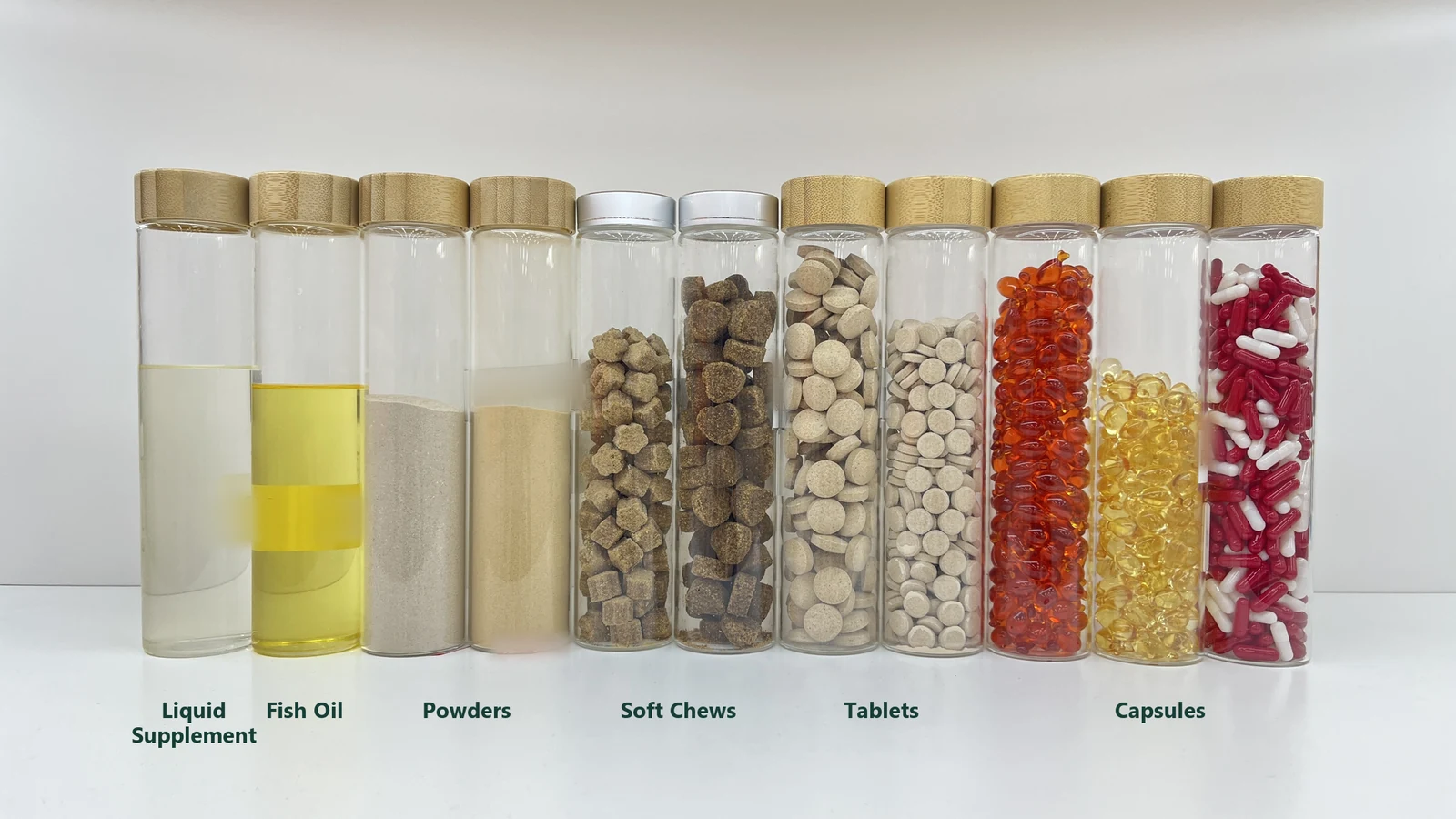
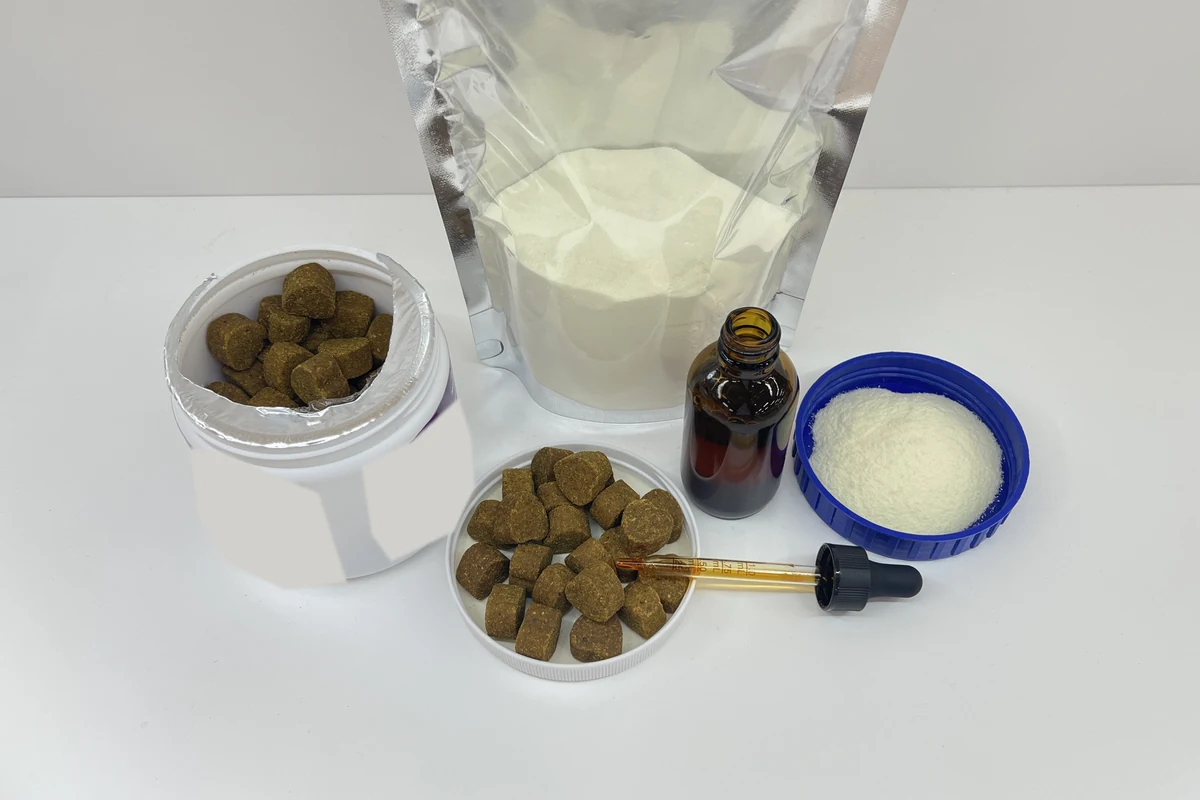
Soft Chews, Powders, Tablets, Capsules, Liquid Drops, and Nutritional Oils Compared
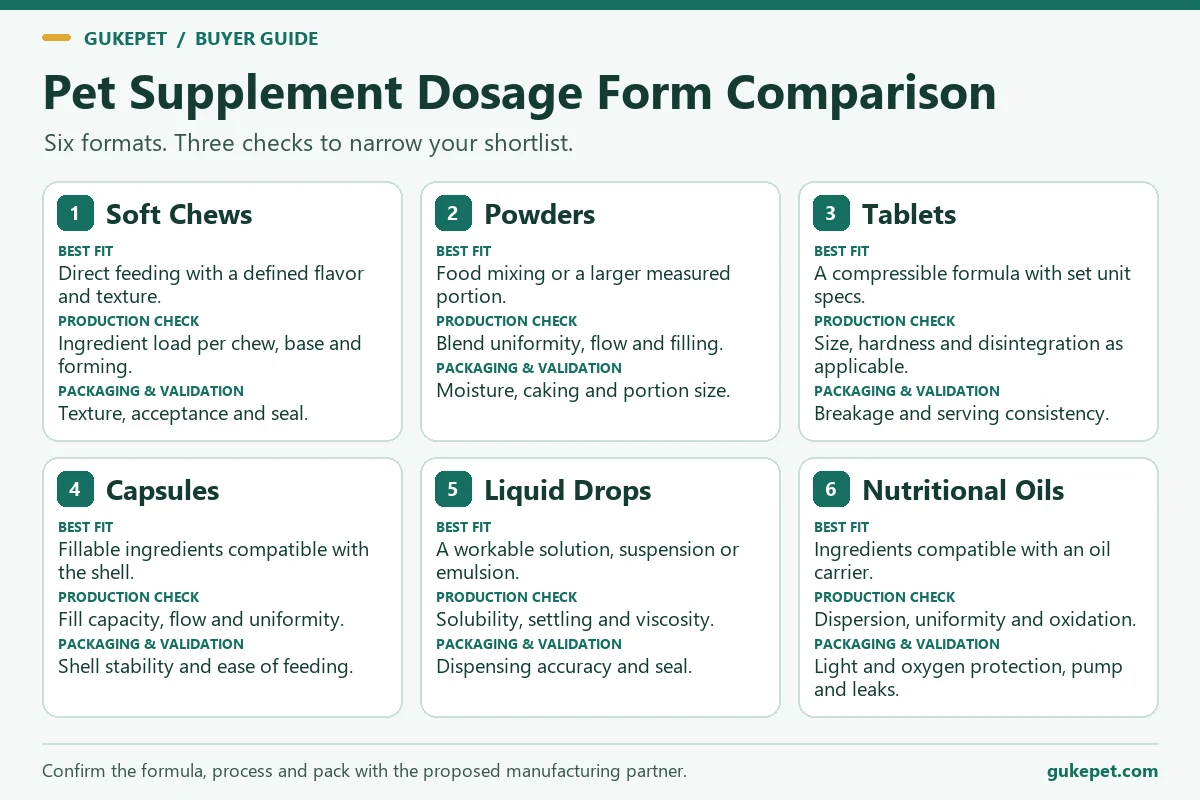
Use the matrix to identify what needs investigation. It describes selection factors, not guaranteed capabilities or a ranking of nutritional performance.
| Dosage Form | Suitable Product Requirements | Key Manufacturing Considerations | Packaging & Validation Priorities |
|---|---|---|---|
| Soft Chews | Direct feeding with defined flavor and texture. | Ingredient load per unit; space for the base; forming and flavor. | Texture stability, acceptance, and sealing. |
| Powders | Food mixing or a larger measured serving. | Ingredient load per portion; flow, blending uniformity, and filling. | Moisture protection, caking, and actual portion measurement. |
| Tablets | Compressible formulas with defined unit specifications. | Compressibility, size, hardness, and appropriate disintegration targets. | Breakage, serving consistency, and feeding practicality. |
| Capsules | Fillable ingredients compatible with the selected shell. | Bulk density, fill capacity, ingredient properties, and uniformity. | Shell stability, storage, and feeding convenience. |
| Liquid Drops | A workable solution, suspension, or emulsion. | Solubility, settling, viscosity, uniformity, and filling. | Dispensing accuracy, sealing, leakage, and stability. |
| Nutritional Oils | Ingredients suitable for an oil-based carrier. | Oil compatibility, dispersion uniformity where needed, and oxidation control. | Light/oxygen protection, pump performance, and leakage. |
How to Eliminate Unsuitable Formats Early
Eliminate options that cannot meet the required ingredient amounts or a manageable serving size. Then investigate process compatibility and stability, feeding practicality, packaging, and commercial requirements. If evidence is missing, record the open question rather than assuming that the format is suitable.
Which Pet Supplement Dosage Form Fits Your Product?
Soft Chews — Palatability, Texture, and Ingredient Loading
A soft-chew base occupies part of each unit. Ingredient loading must leave room for workable flavor, texture, forming, and stability. Assess the complete formulation and proposed unit weight; the weight of a chew is not its active-ingredient content.
Powders — Larger Serving Sizes and Food Mixing
Powders are worth evaluating when the formula needs a larger portion and food mixing is acceptable. Check blend uniformity, flow, moisture sensitivity, caking, and filling into jars or sachets. A scoop measures volume; serving consistency and complete consumption of the mixed food still need assessment.
Tablets — Compressibility, Tablet Size, and Consistency
A tablet requires a blend that compresses reliably into a practical size. Review hardness, breakage, weight and content consistency, and disintegration where appropriate to the specification. A physically robust tablet must still be manageable for the intended feeding method.
Capsules — Fill Capacity and Ingredient Compatibility
Capsule size, ingredient bulk density, flow, and shell compatibility determine whether the required fill is practical. Assess filling consistency, storage, and administration. A powder-filled hard capsule and an oil-filled softgel involve different processes; feasibility for one does not establish capability for the other.
Liquid Drops — Solubility, Uniformity, and Dosing Accuracy
Distinguish a dissolved solution from a suspension or emulsion. Ingredients do not all dissolve in the chosen carrier. Check settling, redispersion, viscosity, filling, and the amount delivered by the actual dropper or pump, including the intended instructions for use.
Nutritional Oils — Oil Compatibility, Oxidation, and Packaging
Review ingredient compatibility with the oil phase, oxidation, odor, and light and oxygen exposure. A non-oil-soluble ingredient does not automatically form a stable oil product. Any dispersion requires technical review and uniformity assessment alongside closure and dispensing performance.
For available product directions, Explore Pet Supplement Formats. Project suitability remains formula-specific.
Soft Chews vs. Powders: Which Is Better for Your Brand?
When Your Formula Requires a Higher Ingredient Load
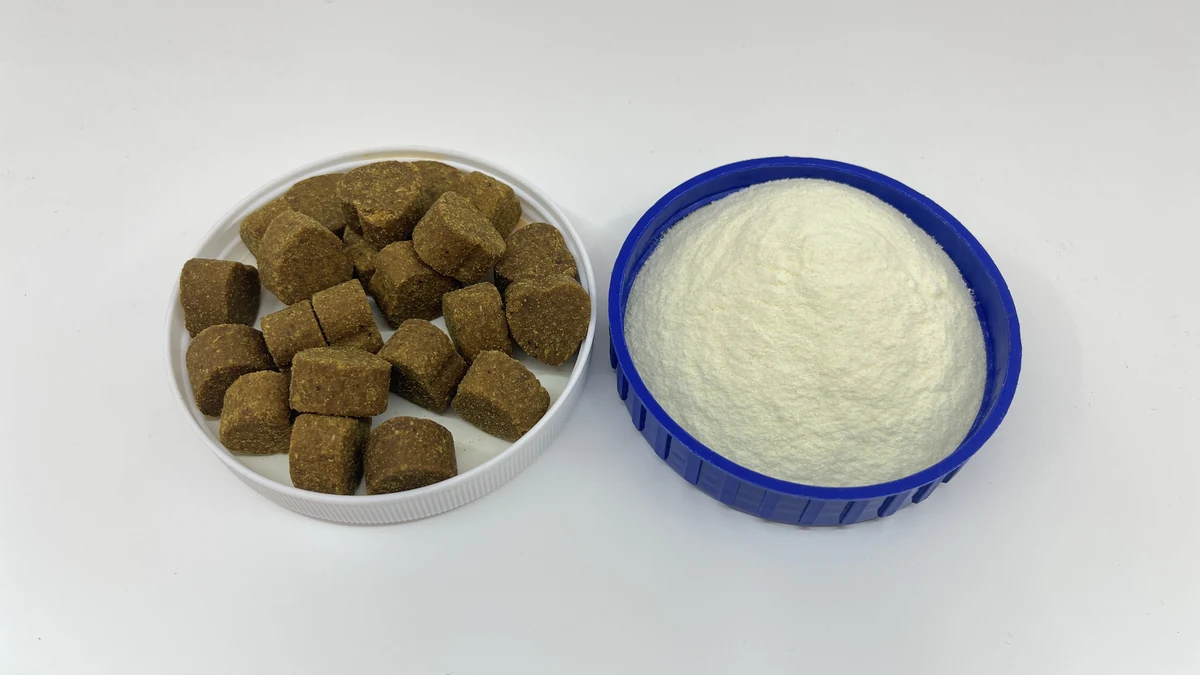
Compare both options against the same target ingredient amounts per serving. A chew needs a workable base; a powder may also need carriers or flavoring. A larger powder portion can be useful, but it is not proof that every high-load formula will work.
Palatability and Everyday Feeding Experience
Direct feeding and food mixing create different routines. Evaluate flavor, texture, handling, and whether the animal consumes the full portion. Neither format guarantees acceptance, and owner convenience should be assessed alongside the animal’s response.
Manufacturing, Stability, and Packaging Constraints
Chews require control of forming and texture; powders require consistent blending and filling. Both need suitable protection and validation. Neither is automatically cheaper or more stable.
| Decision Factor | Soft Chews | Powders |
|---|---|---|
| Serving size | Check unit size and chew count. | Check measured portion size. |
| Ingredient load | Allow space for the chew base. | Review the complete blend and portion. |
| Feeding method | Evaluate direct feeding. | Evaluate mixing and full food intake. |
| Palatability | Assess flavor and texture. | Assess acceptance in intended food. |
| Manufacturing | Check forming and unit consistency. | Check blend uniformity and filling. |
| Stability | Monitor texture and relevant quality attributes. | Monitor caking and relevant quality attributes. |
| Packaging | Validate closure and product protection. | Validate moisture protection and measurement. |
When Should You Sample Both Formats?
Sample both when each appears technically feasible and feeding preference remains uncertain. Use shared ingredient and serving targets with predefined criteria for acceptance, physical stability, packaging, and scale-up. Record trade-offs before selecting the commercial format.
How Ingredient Properties and Manufacturing Processes Limit Dosage Form Selection
Ingredient Solubility and Physicochemical Properties
Review the actual raw-material grade, particle properties, density, and compatibility with the intended carrier. An ingredient name alone does not establish solubility or performance. Suspensions and emulsions need their own uniformity and stability assessment; a mixture that looks uniform initially may change during storage.
Heat, Moisture, Pressure, and Processing Conditions
Assess exposure during processing and storage, including heat, moisture, pressure, and oxygen where relevant. Research comparing probiotic strains illustrates why processing tolerance cannot be assumed from the word “probiotic.” Confirm strain, formulation, process, packaging, and viable-count targets through appropriate finished-product validation.
Active Ingredient Levels, Excipients, and Dose Consistency
Carriers, binders, flavors, and other excipients affect loading and processing. Distinguish calculated ingredient input from verified active content. Define suitable consistency checks for the format; theoretical mixability does not establish reproducible manufacturing or uniform delivery in every serving.
How Palatability, Stability, and Packaging Work Together
Texture, Moisture, Caking, Sedimentation, and Oxidation
Monitor the failure modes relevant to the product: texture change, powder caking, tablet or capsule deterioration, sedimentation, or oil oxidation. Moisture content and water activity are different measurements. Establish appropriate specifications and shelf-life evidence rather than assigning one shelf life to an entire dosage form.
How Packaging Protects the Product and Supports Usability
Evaluate bottles for chews, tablets, or capsules; jars, pouches, or sachets for powders; and compatible liquid or oil containers. Required moisture, oxygen, and light protection depends on the formula. Test seals, product-contact compatibility, transport conditions, and the chosen dispensing system.
Product Condition After Opening and Feeding Convenience
Repeated opening, humidity, reclosure, and handling can change product condition or serving accuracy. Consider in-use hygiene, readable instructions, and reliable liquid output. Review Pet Supplement Packaging Coordination alongside formulation decisions, before artwork and pack specifications are finalized.
What Should You Validate Before Finalizing a Dosage Form?
Formula and Sample Specification Review
Tie each sample to a dated specification revision. Confirm ingredient requirements, serving size, unit weight or fill, and relevant appearance, texture, or flow targets. Attractive appearance alone is not an acceptance criterion for the finished formula.
Uniformity, Stability, and Packaging Compatibility
Agree on a proportionate validation plan. Depending on the formula and risks, evidence may include content uniformity, relevant ingredient assays, microbiological testing, stability, physical behavior, seal performance, and packaging compatibility. Every project does not require an identical test panel.
Palatability and Actual Serving Acceptance
Define what the assessment can demonstrate. Informal feeding observations, structured acceptance evaluations, and formal research provide different evidence. Record whether the intended portion is consumed under the proposed feeding method; do not turn limited observations into broad efficacy or preference claims.
From Prototype to Commercial Production
A successful prototype does not guarantee a successful commercial batch. Confirm scale-up feasibility, production conditions, approved specifications, acceptance criteria, and relevant quality records with the manufacturing partner. Resolve material changes before treating the sample as a production reference.
| Validation Item | What to Check | Evidence Required | Decision / Notes |
|---|---|---|---|
| Formula Specification | Ingredient and serving targets. | Approved specification revision. | Resolve any target mismatch. |
| Serving Consistency | Unit, fill, or measured portion. | Relevant uniformity and dispensing checks. | Define acceptable variation. |
| Physical Stability | Format-specific changes during storage. | Appropriate stability observations and tests. | Set evidence-based storage conditions. |
| Packaging Compatibility | Contact materials, closure, and output. | Compatibility, seal, and dispensing results. | Resolve protection or usability failures. |
| Feeding Acceptance | Practical delivery and full portion intake. | Documented assessment suited to the question. | Record limitations and unresolved issues. |
| Manufacturing Scale-Up Feasibility | Repeatability under commercial conditions. | Partner review and relevant production evidence. | Approve only against agreed criteria. |
How MOQ and Commercial Requirements Affect Dosage Form Selection
Different Dosage Forms May Have Different MOQ Requirements
Minimums can come from production batches, raw materials, packaging, tooling, or separate SKUs. Changing the format can change several minimums simultaneously. Confirm the actual project requirements with the relevant manufacturing and packaging partners rather than assuming one MOQ applies to all formats.
Match the Dosage Form to Your Order Size and Budget
Review initial quantity, customization, pack size, serving requirements, and budget together. Standard packaging or a revised serving configuration may offer practical options, but changes must preserve the approved product requirements. Commercial feasibility does not replace technical suitability.
Why the Lowest Cost per Bottle Is Not Always the Best Choice
Bottles may contain different ingredient amounts, serving counts, or packaging specifications. Compare equivalent requirements before judging price. For the separate cost assessment, Understand Pet Supplement Manufacturing Costs.
How to Choose the Right Dosage Form for Your Brand
A Five-Step Dosage Form Selection Framework
- Define Your Formula and Serving Requirements. Document ingredients, target amounts, animal, market, and feeding method.
- Eliminate Technically Unsuitable Formats. Screen loading, carrier compatibility, serving practicality, and process constraints.
- Evaluate Stability and Feeding Experience. Identify evidence needed for storage behavior and complete portion intake.
- Review Packaging and Commercial Requirements. Align protection, dispensing, pack size, MOQ, and budget.
- Validate Samples and Manufacturing Feasibility. Assess samples against agreed criteria and resolve scale-up questions.
What to Provide If You Already Have a Formula
Share the specification, ingredient potencies, serving targets, preferred format, market, packaging, estimated quantity, and budget. Agree on confidentiality arrangements before sharing proprietary details. Gukepet coordinates manufacturing-resource matching and project review; partner feasibility must be confirmed for the actual formula.
How to Start If You Have a Product Idea and Budget
Provide the concept, core ingredients, target animal, destination, positioning, quantity, and packaging preferences. Include a target EXW price if known. Gukepet connects formulation, manufacturing, and packaging resources to evaluate practical options; this does not guarantee that every concept fits every budget. Explore Pet Supplement OEM/ODM Options.
Discuss Your Formula & Dosage Form
Have an existing formula or a new product idea? Share your ingredient requirements, target serving size, preferred format, estimated order quantity, and budget. Gukepet can help you evaluate suitable dosage-form and manufacturing options in China.
Frequently Asked Questions About Pet Supplement Dosage Forms
Which pet supplement dosage form is best for a new brand?
There is no universal best format. Start with the formula, serving size, target animal, and feeding method, then assess manufacturing feasibility, packaging, budget, and MOQ. Use samples to resolve the most important uncertainties.
Are soft chews or powders better for pet supplements?
Soft chews support a direct-feeding approach; powders can suit food mixing and larger portions. The better fit depends on ingredient loading, acceptance, processing, stability, and packaging. Compare both against the same product requirements.
Which dosage form is suitable for higher ingredient loads?
Powders are worth assessing when a larger measured portion is practical. However, loading depends on the complete formula, ingredient properties, serving size, and feeding method. There is no single upper limit that applies to every product.
Can probiotics be made into soft chews or liquids?
Feasibility depends on the strain, formulation, processing conditions, storage, and packaging. Define viable-count targets and obtain relevant finished-product evidence. Neither soft chews nor liquids should be accepted or rejected for every probiotic without a specific technical review.
What is the difference between liquid drops and nutritional oils?
Liquid drops describe a dispensing format and may contain a solution, suspension, or emulsion. Nutritional oils use an oil-based carrier and may also be dispensed as drops. Review carrier compatibility, uniformity, oxidation, and dispensing—not assumed absorption advantages.
Does changing the dosage form affect MOQ and packaging?
It can change the manufacturing process, raw-material minimums, packaging, tooling, and sampling needs. Confirm revised specifications and project-specific minimums before proceeding; do not transfer a quotation or MOQ unchanged from one format to another.
Can Gukepet help evaluate different dosage forms for my existing formula?
Yes. Gukepet can coordinate review with suitable manufacturing and formulation resources, covering loading, process feasibility, packaging, MOQ, and project execution. Final suitability depends on technical assessment and validation of your specific requirements.
Discuss Your Formula & Dosage Form
Have an existing formula or a new product idea? Share your ingredient requirements, target serving size, preferred format, estimated order quantity, and budget. Gukepet can help you evaluate suitable dosage-form and manufacturing options in China.