
Knowing how to choose a pet supplement manufacturer starts with matching your product requirements to verifiable production resources. For B2B brands, the decision also depends on formula suitability, quality evidence, workable commercial terms, communication, and clear responsibilities.
This guide follows a practical screening process, from the initial brief to a 14-item Manufacturer Evaluation Checklist.
Define Your Product Requirements Before Contacting Manufacturers
Formula and ingredient requirements
Specify whether you need an existing private-label formula, production of your own formula, or new development. For an established formula, prioritize partners that can assess your ingredient specifications, amounts per serving, and quality requirements. For development, define the product direction, market, and budget before requesting proposals.
Dosage form and finished-product specifications
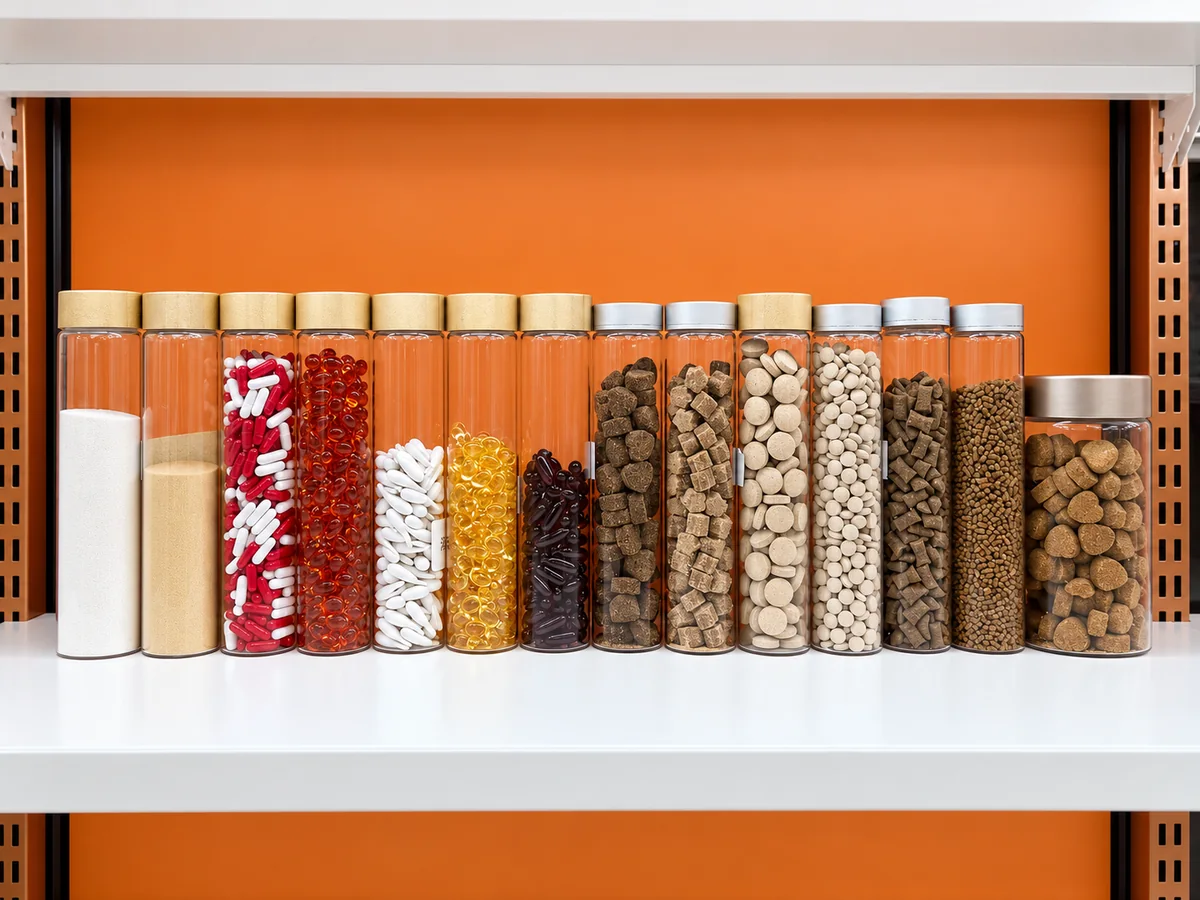
Identify soft chews, powders, tablets, capsules, liquid drops, nutritional oils, or nutritional pastes. State unit weight, serving size, bottle or pouch count, container capacity, and intended use. Include flavor, shape, stability, filling, and packaging expectations. Each format may involve different processes and production limits.
Target market, order quantity, and budget
Name the destination country, expected first order, likely replenishment volume, and manufacturing budget. Record special labeling, testing, documentation, or import needs. Treat the United States, United Kingdom, and individual EU markets as separate review contexts; a supplier’s experience in one does not establish suitability for another.
Prepare one complete product brief
Use this brief checklist: formula route; ingredient specifications; format; serving; count/fill; packaging; destination; quantity; budget; quality documents; launch timing. Give candidates the same revision. This reduces mismatched quotations, unsuitable MOQs, repeated sampling, and misunderstandings about what the factory can produce.
Where to Find and Shortlist Pet Supplement Manufacturers in China
Use several sourcing channels
Google Search and B2B platforms help identify candidates; trade shows allow direct discussion; referrals provide introductions; sourcing partners can help match requirements with resources. A business describing itself as a manufacturer may coordinate some of its catalog through other production companies.
Build a focused shortlist
Screen for the target format, relevant product experience, willingness to evaluate your formula, plausible MOQ fit, available market-related documents, and responsive project communication. Investigate a manageable number of well-matched candidates deeply. A long contact list alone provides little evidence of suitability.
Treat marketing information as leads
Record the company name, website, address, contacts, product range, facility images, and claimed certificates. Ask which entity manufactures your proposed product. Keep the source and date of each claim, then obtain supporting evidence. Promotional photographs and brochures cannot establish ownership, current capability, or certification scope.
How to Verify a Pet Supplement Manufacturer in China
Identify the legal entities and production site
Request full legal names, registration information, registered and operating addresses, and relevant business qualifications. Map the seller, contracting entity, actual manufacturer, and subcontracted packing or processing parties. Compare these details across quotations, documents, and proposed contracts. Different entities can legitimately participate; their relationships and responsibilities should be transparent.
Verify the processes your product needs
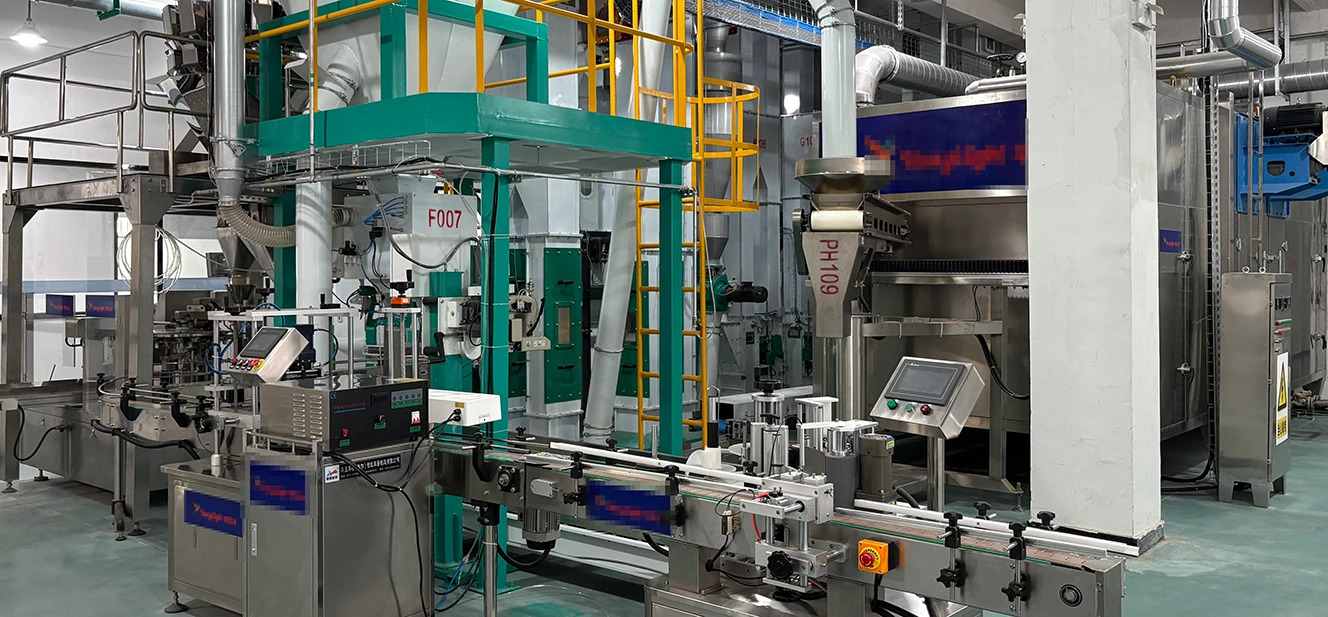
Use a live video discussion, site visit, or appropriately scoped independent audit to follow the proposed production route. Ask to see the relevant operations, equipment, and records. Establish whether the facility processes raw materials, purchases semi-finished goods, or outsources stages. For subcontracted work, identify the operator and quality-control arrangements.
Check certificate holder, scope, and current status
Read the legal name, covered site, certificate number, issuing body, dates, current status, and scope. Cross-check through the issuer or an applicable accreditation verification channel. ISO explains that external certification bodies issue certificates; ISO itself does not. Where relevant, use the verification routes it identifies, including IAF CertSearch.
ISO management-system certification, HACCP-related records, and GMP-related documentation have different purposes and bases. Ask what each document establishes for this facility and process. There is no universal certificate bundle suitable for every pet product or destination.
Distinguish FDA facility registration from approval
For applicable animal-food facilities, FDA states that registration does not imply approval or endorsement. FDA does not issue or recognize third-party food-facility registration certificates. Establish the registration’s relevance and status rather than relying on a certificate-style graphic.
Registration, third-party certification, and product compliance are separate questions. FDA’s animal-product guidance also distinguishes animal food and drugs from human dietary supplements. Assess classification and intended claims for the actual product.
Evaluate Formulation Support and Manufacturing Capabilities
Ask for feedback on your actual specification
Request a technical review covering ingredient sourcing, process fit, necessary changes, and sampling. Clarify whether the team offers stock formulas, formula transfer, adjustments, or new development, and who provides that support. OEM production experience alone does not demonstrate a complete in-house research function.
Check capability separately for each format
Use this manufacturing capability review to frame specific questions. A powder line or a broad catalog does not establish capability for every other format. Explore Pet Supplement Formats when defining the brief.
| Format | Process evidence to request | Technical questions |
|---|---|---|
| Soft chews | Mixing, forming, and moisture-control operations | Weight, texture, flavor, and process stability |
| Powders | Blending and filling controls | Uniformity, flow, scoop size, and fill accuracy |
| Tablets | Compression, tooling, and relevant finishing steps | Size, hardness, ingredient behavior, and consistency |
| Capsules | Encapsulation and weight-control arrangements | Capsule size, fill weight, and blend flow |
| Liquid drops | Mixing, filling, and closure checks | Solubility, sedimentation, dispensing, and leakage |
| Nutritional oils | Oil handling, filling, and sealing operations | Stability, container compatibility, and seal integrity |
| Nutritional pastes | Mixing, consistency control, filling, and sealing | Consistency, dispensing, fill accuracy, and packaging compatibility |
Identify scale-up limits before approval
Ask about achievable fill or unit weight, raw-material flow, blend uniformity, forming behavior, stability, and packaging compatibility. Record unresolved risks and the trials needed. A theoretically workable formula or small laboratory sample may require adjustment before consistent production on the selected equipment.
Assign technical and production responsibilities
Identify who evaluates the formula, manufactures the product, supplies packaging, arranges testing, and follows delivery. Record handoffs and approval authority when several parties participate. Explore Pet Supplement OEM/ODM Options for Gukepet’s manufacturing-resource coordination approach.
Review Quality Control, COAs, Testing, and Sample Consistency
Request documents with a defined purpose
Product specifications define agreed requirements; COAs summarize reported results for an identified sample or batch; testing reports provide additional detail. Request applicable facility and project records separately. Availability depends on the product, partner, and batch. One COA cannot answer every quality or compliance question.
Verify testing scope and report origin
Consider microbiological testing, heavy metals, active-ingredient verification, and product-specific checks according to the formula and market. Match the report’s sample identity, batch, date, methods, results, and limits to your requirements. Verify the laboratory and relevant competence; agree on additional testing where evidence is incomplete.
Review traceability and deviation handling
Ask for an explanation of raw-material lot records, finished-batch identification, and production records. Discuss how an abnormal result is recorded, investigated, corrected, and communicated. Request evidence that connects records for the proposed process rather than accepting an unsupported claim of complete traceability.
Connect approved samples to batch acceptance
Record the approved formula and sample revision, product specifications, appearance, testing expectations, and packaging artwork. Agree on production acceptance checks and change approval before manufacture. An approved sample is a reference; process controls and batch checks support consistency. Review Pet Supplement Quality Documentation for available coordination support.
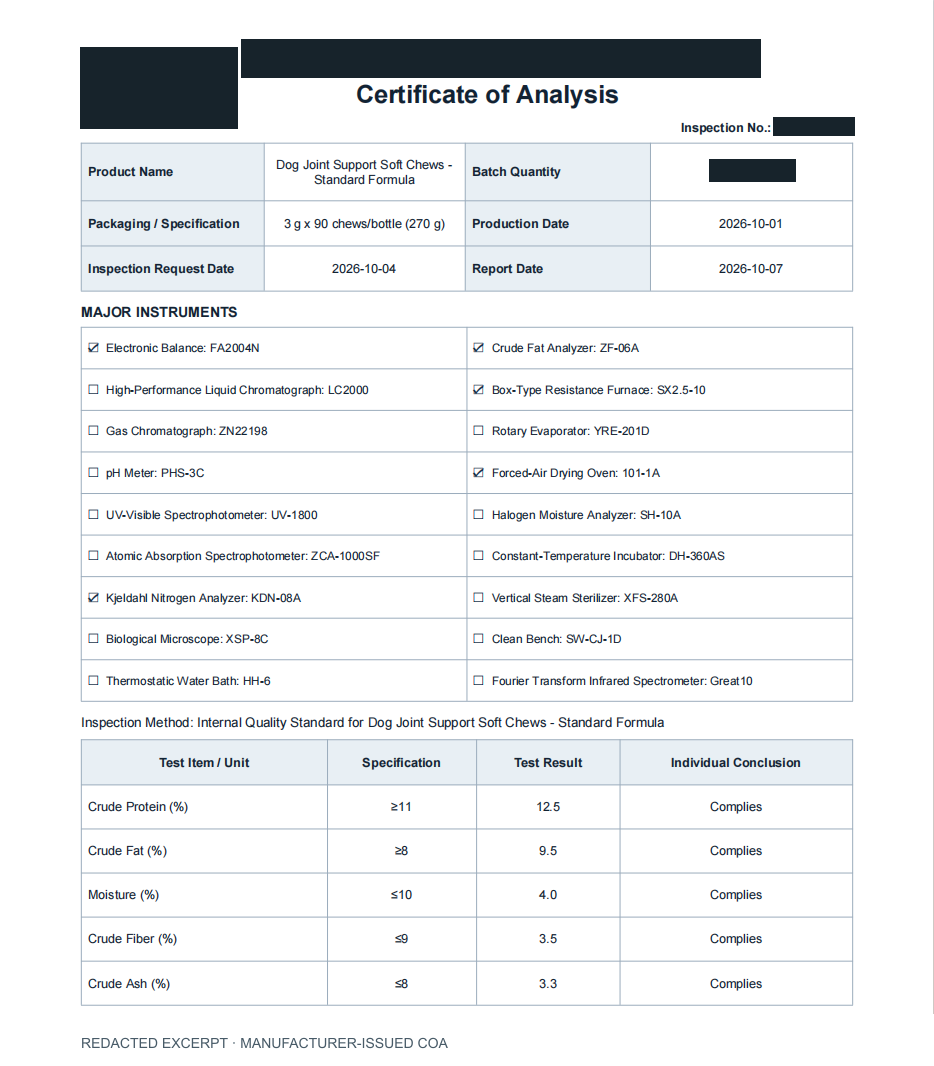
Public examples may be redacted for confidentiality. For supplier approval, request complete issuer and batch details through an agreed confidential review process, then verify the report against your product specification.
Compare MOQ, Lead Times, Quotations, and Commercial Terms
Confirm MOQ for launch and replenishment
Confirm MOQ by formula, format, packaging, SKU, and flavor, including repeat orders and unused packaging materials. Manufacturing and packaging minimums may differ. Pet Supplement Packaging Coordination can help align component decisions with the project.
Selected established formulas from Gukepet’s manufacturing partners may start at approximately 500 bottles; some custom-formula projects typically start at approximately 1,000 bottles. These are project-dependent starting points, not industry-wide minimums or guarantees for every SKU.
Compare the same quotation scope
Confirm specifications, included packaging, testing, documents, sampling, tooling, trade terms, the named delivery place, and quote validity. Use the commercial review below; for detailed cost planning, Understand Pet Supplement Manufacturing Costs in China.
| Commercial item | Evidence to compare | Decision question |
|---|---|---|
| MOQ | Minimums per SKU and packaging component | Does the commitment fit launch and reorders? |
| Lead time | Stages, dependencies, and start conditions | What must happen before each stage begins? |
| Quote scope | Specification, inclusions, exclusions, and validity | Are offers based on the same deliverable? |
| Samples and documents | Deliverables, charges, and acceptance criteria | Can evidence be reviewed before commitment? |
| Responsibilities | Contract, payment, quality, and delivery terms | Who resolves delays or nonconforming goods? |
Map the schedule and its dependencies
Request stages for sampling, ingredient procurement, packaging or printing, production, testing, release, and shipment preparation. Clarify when each stage begins and who approves the next step. Use project-specific commitments rather than an assumed industry-wide lead time.
Agree on contracts, payment, and confidentiality
Document the contracting party, payment milestones, formula confidentiality, intellectual-property arrangements, specifications, acceptance, delivery responsibilities, and dispute process. Obtain appropriate professional review for the actual agreement. Resolve inconsistent responsibilities before paying or disclosing proprietary technical information.
Direct Factory vs. Manufacturing Sourcing Partner: Which Is Better?
Consider the direct-factory route
A direct relationship can simplify technical communication when a facility already fits a mature product. Expansion into other formats may require additional suppliers, while development, packaging, or testing can still involve outside parties. Compare the actual workflow and responsibilities rather than assuming direct sourcing always costs less.
Assess a sourcing partner’s contribution
Gukepet helps match product requirements with production resources, compare cost and MOQ, and coordinate formulation, packaging, samples, and follow-up. Assess what the partner will deliver, which entities perform each operation, and who handles project issues.
Require transparency under either model
Confirm the manufacturer, site, process responsibilities, document holders, payment arrangements, and escalation contact. Whether working with a factory or coordinator, assess transparent responsibilities and evidence of the proposed work.
Choose the model that fits your team
Consider formula maturity, formats, development and packaging needs, order scale, and your team’s supplier-management capacity. A direct relationship may suit one established product; coordinated sourcing may help manage several resources.
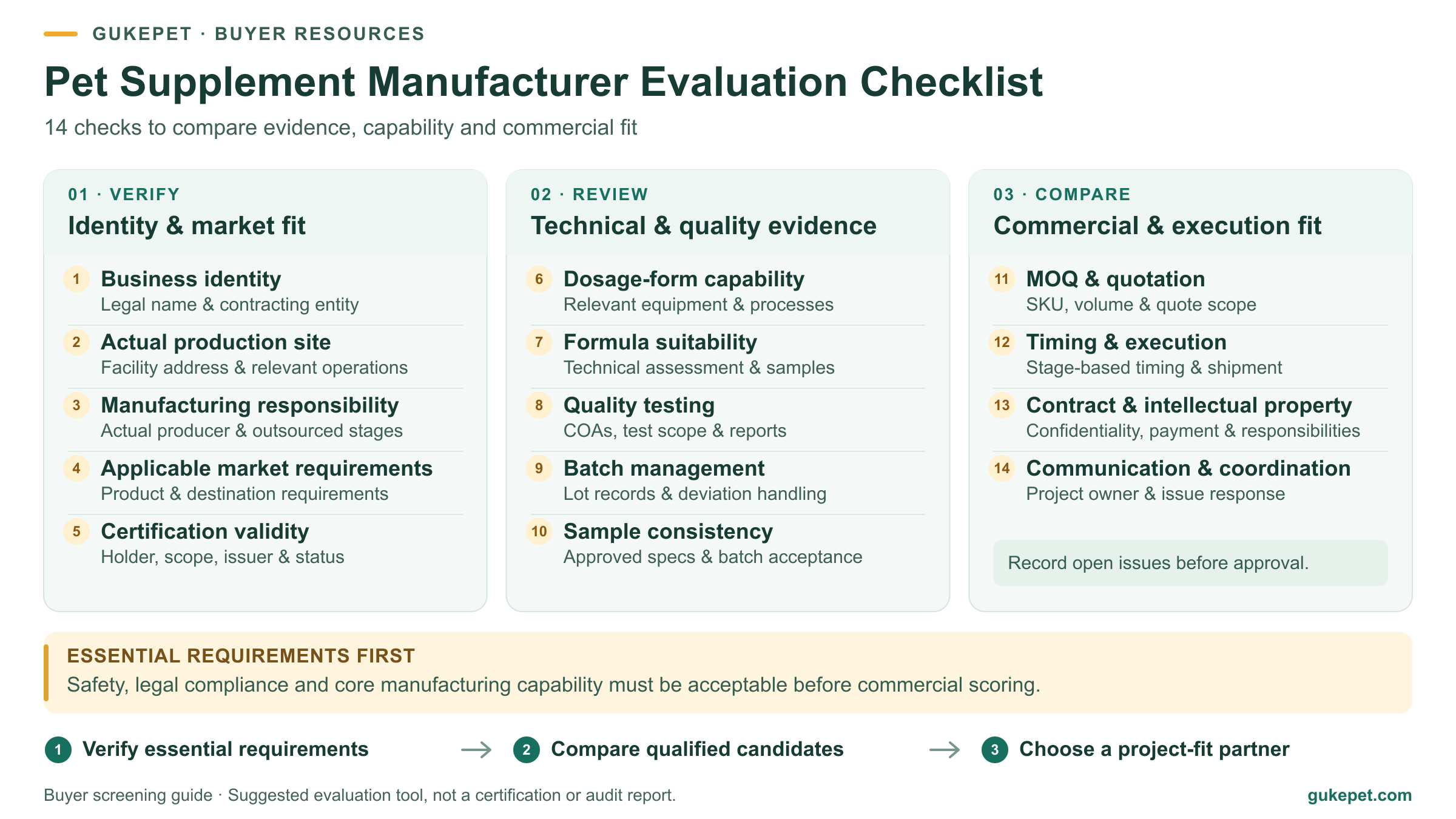
Pet Supplement Manufacturer Evaluation Checklist
Start with basic qualification
Verify the legal identity, actual site, manufacturing responsibilities, destination requirements, and applicable documents. Resolve identity or safety concerns before scoring.
Compare technical and quality evidence
Review format capability, formula fit, testing, batch records, and sample-to-production controls against your specification. Record open issues for follow-up.
Assess commercial and execution fit
Use the checklist below to compare MOQ, quote scope, stage-based timing, contractual responsibilities, confidentiality, and communication.
| Evaluation item | Evidence to request | Review type |
|---|---|---|
| 1. Business identity | Legal name, registration information, and contracting entity | Basic verification |
| 2. Actual production site | Facility address and evidence of relevant operations | Basic verification |
| 3. Manufacturing responsibility | Actual producer and explanation of subcontracted stages | Basic verification |
| 4. Applicable market requirements | Product- and destination-related compliance information | Critical condition |
| 5. Certification validity | Holder, scope, current status, and issuing body | Verify where applicable |
| 6. Dosage-form capability | Relevant equipment, processes, and production examples | Technical review |
| 7. Formula suitability | Technical assessment, samples, or feasibility feedback | Technical review |
| 8. Quality testing | COAs, agreed test scope, and relevant reports | Quality review |
| 9. Batch management | Lot traceability, records, and deviation-handling process | Quality review |
| 10. Sample consistency | Production specifications and batch acceptance arrangements | Quality review |
| 11. MOQ and quotation | SKU, quantity, specifications, and quotation scope | Commercial comparison |
| 12. Timing and execution | Sampling, production, packaging, inspection, and shipment stages | Commercial comparison |
| 13. Contract and intellectual property | Confidentiality, responsibilities, payment, and dispute arrangements | Cooperation risk |
| 14. Communication and coordination | Issue response, technical communication, and project owner | Execution review |
Make the final decision in two stages
First exclude candidates that fail essential requirements. Then compare those remaining. For internal notes, use 0 for insufficient evidence or an unmet requirement; 1 for partial fit needing review; and 2 for evidence supporting the requirement. This is a suggested purchasing tool, not an international certification scheme. High scores elsewhere cannot offset failures in product safety, legal compliance, or essential manufacturing capability.
How Gukepet Helps You Review Suitable Manufacturing Options
For brands with an existing formula
Share the formula, format, specifications, packaging, quantity, budget, market, and special quality or document requirements. Agree on confidentiality before sharing proprietary details. These inputs support a review of manufacturing fit and candidate production approaches.
For brands developing a new product
Provide the product direction, customer, destination, preferred format, specifications, target retail positioning or manufacturing budget, initial volume, and packaging concept. Gukepet can coordinate relevant development and manufacturing resources to discuss workable options, subject to technical and commercial review.
For coordinated supplier evaluation and follow-up
Based in Yiwu, China, Gukepet provides manufacturing-resource matching, sourcing support, and project coordination. Support can cover suitability review, cost and MOQ comparison, formulation and packaging coordination, sampling, production follow-up, and available quality documents. Manufacturing and testing remain with the relevant partners; their facilities and credentials are their own.
For buyers without a China freight forwarder, Gukepet can coordinate door-to-door options through logistics partners. Any DDP (Delivered Duty Paid) proposal requires product- and destination-specific review, with the named delivery place, importer arrangements, included charges, and exclusions confirmed in writing.
Request a Manufacturing Partner Review
Have a formula or a new product in mind? Share your product specifications, target market, estimated order quantity, and budget. Gukepet can help you review suitable manufacturing options in China.
Frequently Asked Questions About Choosing a Pet Supplement Manufacturer
How do I verify a pet supplement manufacturer in China?
Verify legal identity, production address, manufacturing responsibilities, applicable documents, relevant processes, and quality records. Cross-check important claims through live discussions, visits, appropriate independent reviews, or document issuers. Website material alone is preliminary evidence.
What certifications should I look for in a pet supplement manufacturer?
Identify documents relevant to the product, facility, and destination. Examine ISO, HACCP, or GMP-related claims by holder, scope, status, and issuer. There is no identical certificate bundle that establishes suitability for every project.
Is FDA registration the same as FDA approval?
No. For applicable food facilities, FDA registration does not establish facility or product approval. Check the FDA guidance linked above and the actual product classification. Animal foods, animal drugs, and human dietary supplements have different regulatory contexts.
Can one manufacturer produce soft chews, powders, tablets, and liquids?
Some may support several formats, but verify each relevant process, equipment arrangement, formula fit, and subcontracted stage. A product catalog does not demonstrate that every operation is performed at the same facility.
What should I check before approving a production sample?
Confirm the formula revision, specifications, ingredient or active levels where relevant, appearance, quality criteria, packaging, and batch acceptance plan. Record the approved reference and change-control process. Sample approval supports production planning but does not replace batch quality control.
Is it better to work directly with a factory or a sourcing partner?
Choose according to manufacturing fit, technical communication, packaging coordination, supplier-management capacity, and transparent responsibilities. Either model can suit a project. Compare the proposed team and workflow rather than deciding by company label alone.
How can I compare pet supplement manufacturers beyond price and MOQ?
Use the 14-item checklist to compare technical fit, quality evidence, applicable credentials, timing, sample consistency, contractual terms, and execution. Resolve essential safety and compliance requirements first, then compare the commercial fit of qualified candidates.