
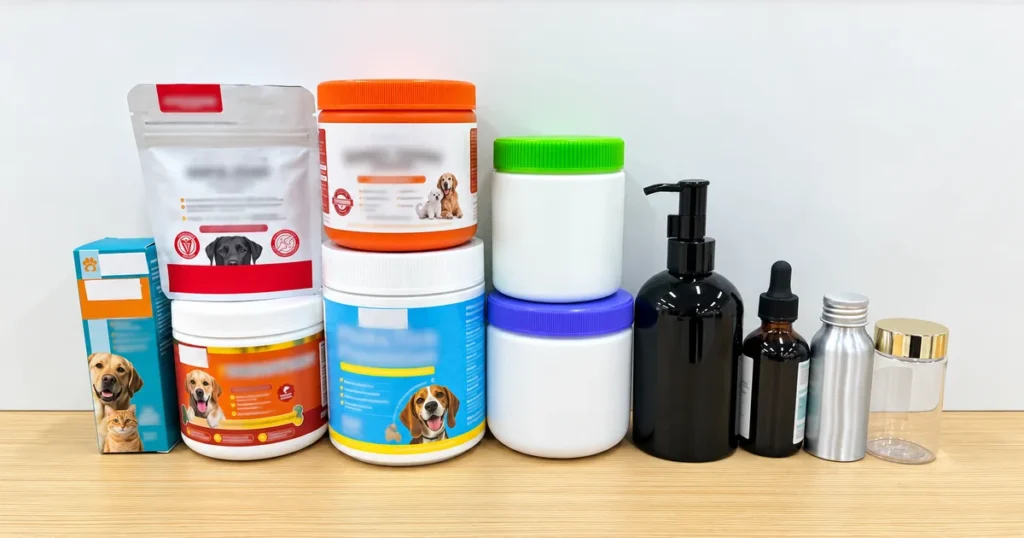
Pet supplement manufacturing cost depends on what a quote includes. Two suppliers can price the same product idea using different ingredient specifications, serving sizes, packaging, testing, quantities, or trade terms. Compare those assumptions before deciding which offer delivers better value.
For pet brands sourcing from China, a useful comparison starts with one specification: formula, dosage form, fill or count, packaging, quality requirements, target market, quantity, and delivery term. This guide explains those variables and how to work backward from a commercial target.
1. What Is Included in a Pet Supplement Manufacturing Quote?
Before comparing prices, ask every potential manufacturing partner to separate the same cost categories.
Formula and ingredient costs
The quote should identify the costed specification: ingredient form and grade, active content, amount per serving, flavor system, excipients, and batch requirements. Low-availability materials, special storage, and small ingredient purchases can affect the result.
Processing and manufacturing loss
Mixing, forming, tableting, encapsulation, filling, drying, and packing require different processes. The quote may also account for expected setup and processing loss. Confirm whether yield is based on finished bottles, total units, or theoretical batch weight.
Packaging, quality checks, and project charges
Clarify whether the price includes the primary container, closure, seal, scoop or dropper, label, carton, master case, testing, samples, artwork setup, tooling, and document preparation. Do not assume that “finished product” means every item is included.
Cost per bottle, unit, and serving
Convert quotes to the same basis. Record net content, units per bottle, serving size, finished quantity, trade term, named place, and validity date. Compare cost per bottle for purchasing, per unit for specification checks, and per serving for positioning.
Quote-scope checklist: formula specification; finished quantity; dosage form; count or fill weight; packaging components; testing scope; documentation; samples or setup fees; overrun/underrun tolerance; trade term; named place; validity period; payment terms; exclusions.
2. How Do Formula and Active Ingredient Levels Affect Manufacturing Cost?
The same formula name can hide different specifications
“Joint support,” “multivitamin,” or “probiotic” is a product direction, not a costable specification. Different ingredient sources, concentrations, strains, carriers, palatability systems, and storage requirements can lead to different quotations.
Specification, active content, and amount per serving
Buyers should compare the amount delivered per serving—not only the input weight of a branded or concentrated raw material. The manufacturer also needs to confirm whether the formula is suitable for the selected format and whether the serving fits the planned tablet, capsule, chew, scoop, or dropper.
Optimize within a budget without weakening the brief
Cost optimization may involve simplifying ingredients, choosing a suitable format, adjusting serving size, or separating essential requirements from optional features. Keep declared actives, safety, quality, labeling, and target-market requirements consistent with the approved brief.
3. Private Label, OEM, and ODM: How Do Their Cost Structures Differ?
Mature-formula private label
A mature formula may reduce development work and use established production and packaging combinations. Buyers still need to confirm the formula, customization, MOQ, testing scope, and target-market fit.
OEM with a buyer-owned formula
With a buyer-supplied formula, compare manufacturing fit, ingredient sourcing, process requirements, quality criteria, confidentiality, and like-for-like cost. Transfer trials or adjustments may still be required.
ODM developed around the commercial brief
An ODM project can begin with the target customer, format, packaging, quantity, claims direction, and cost. It requires more development coordination but may produce greater differentiation.
| Model | Main early-stage work | Typical cost question |
|---|---|---|
| Mature-formula private label | Select and adapt an available option | What is included, and what can be customized? |
| Buyer-formula OEM | Transfer and validate the specification | Can the same formula and quality brief be produced efficiently? |
| Budget-led ODM | Develop a commercially workable concept | Which formula, format, packaging, and MOQ fit the target cost? |
Learn more about Pet Supplement OEM/ODM Services. Gukepet coordinates partner selection and project evaluation. Selected third-party manufacturing partners carry out production.
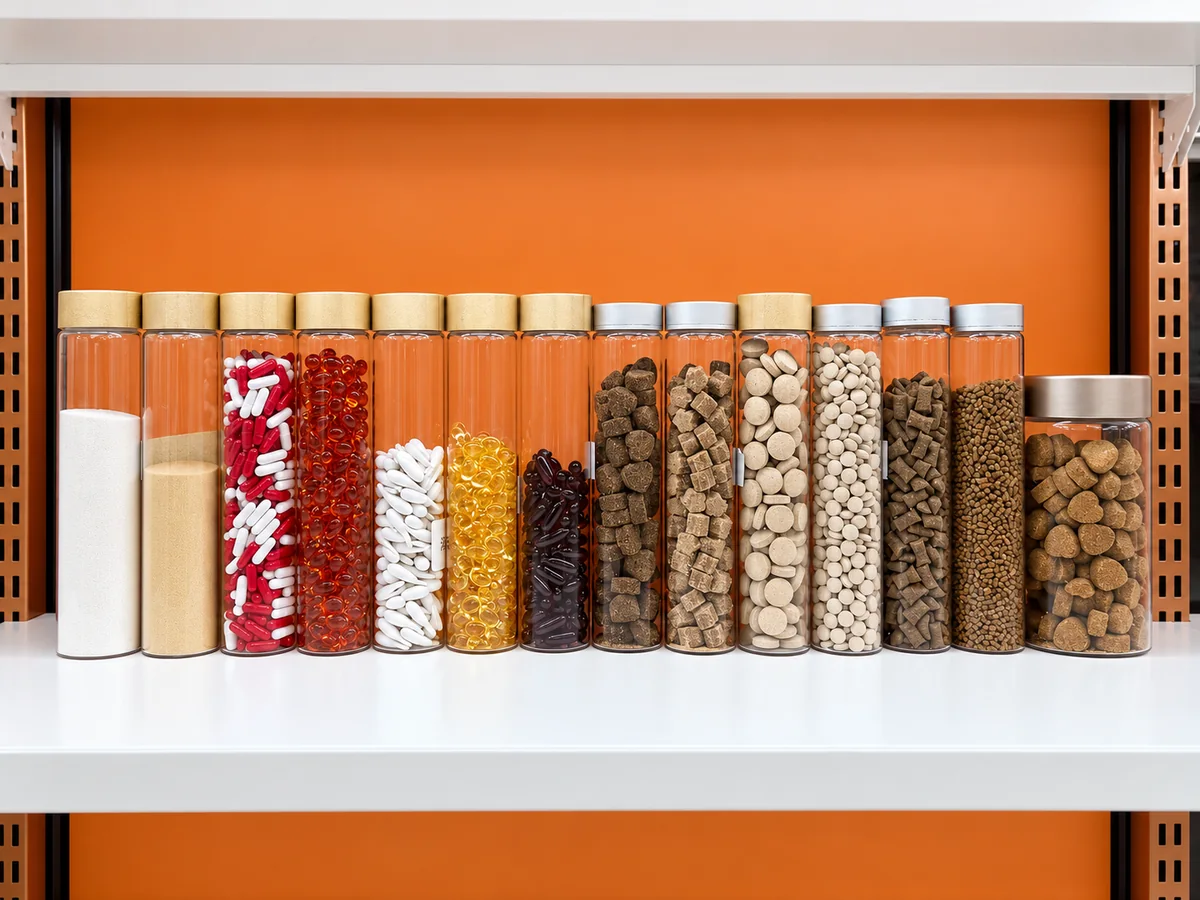
4. How Does Dosage Form Affect Pet Supplement Manufacturing Cost?
Soft chews
Cost drivers include chew weight, count, shape, texture, flavor, moisture control, yield, and container size. Assess palatability and process stability together.
Powders
Powders are influenced by serving weight, blend uniformity, flow, scoop needs, and the choice of jar, pouch, or sachet. A high grams-per-serving formula can increase ingredient and freight costs.
Tablets and capsules
Tablet size, hardness, coating, tooling, capsule size, fill weight, and ingredient behavior affect processing. A paper formula may need adjustment for consistent production.
Liquid drops and oils
Liquid cost depends on compatibility, viscosity, fill volume, bottle and closure, sealing, leakage control, and stability expectations. Droppers and pumps add component considerations.
Pastes
Pastes require attention to viscosity, filling accuracy, tube or syringe compatibility, and sealing. Pack size and dispensing components also affect cost.
Gukepet can match projects with manufacturing partners for common formats, including pastes. Explore Pet Supplement Formats and compare the complete specification and packaging system; no format is always cheapest.
5. Why Does MOQ Affect Cost per Bottle and First-Order Budget?
Manufacturing MOQ and batch economics
A production run carries preparation, cleaning, setup, labor, quality, and documentation work. More units may lower unit cost, but they also commit cash and increase inventory exposure.
Formula and packaging MOQs may not match
The manufacturing batch, a specialty ingredient, bottle color, closure, label, printed carton, or sachet film may each have a different minimum. Ask which component sets the effective MOQ and whether unused printed materials must be purchased or stored.
Comparing 500, 1,000, and larger quantities
Selected mature formulas offered by Gukepet’s manufacturing partners support a minimum order of 500 bottles; custom-formula projects start at 1,000 bottles. Confirm the MOQ for your chosen formula, dosage form, packaging, and SKU. These project starting points are not industry-wide minimums.
Request quantity scenarios using one specification. Compare cash outlay, unit cost, sell-through, shelf-life buffer, packaging commitments, and reorder lead time—not price per bottle alone.
Balance savings against inventory risk
The right first order is the quantity that supports launch and replenishment without creating avoidable stock risk. A slightly higher unit cost at a workable quantity may be more commercial than a lower unit cost tied to excessive inventory.
6. How Can You Choose Pet Supplement Packaging That Fits the Budget?
Standard packaging versus custom packaging
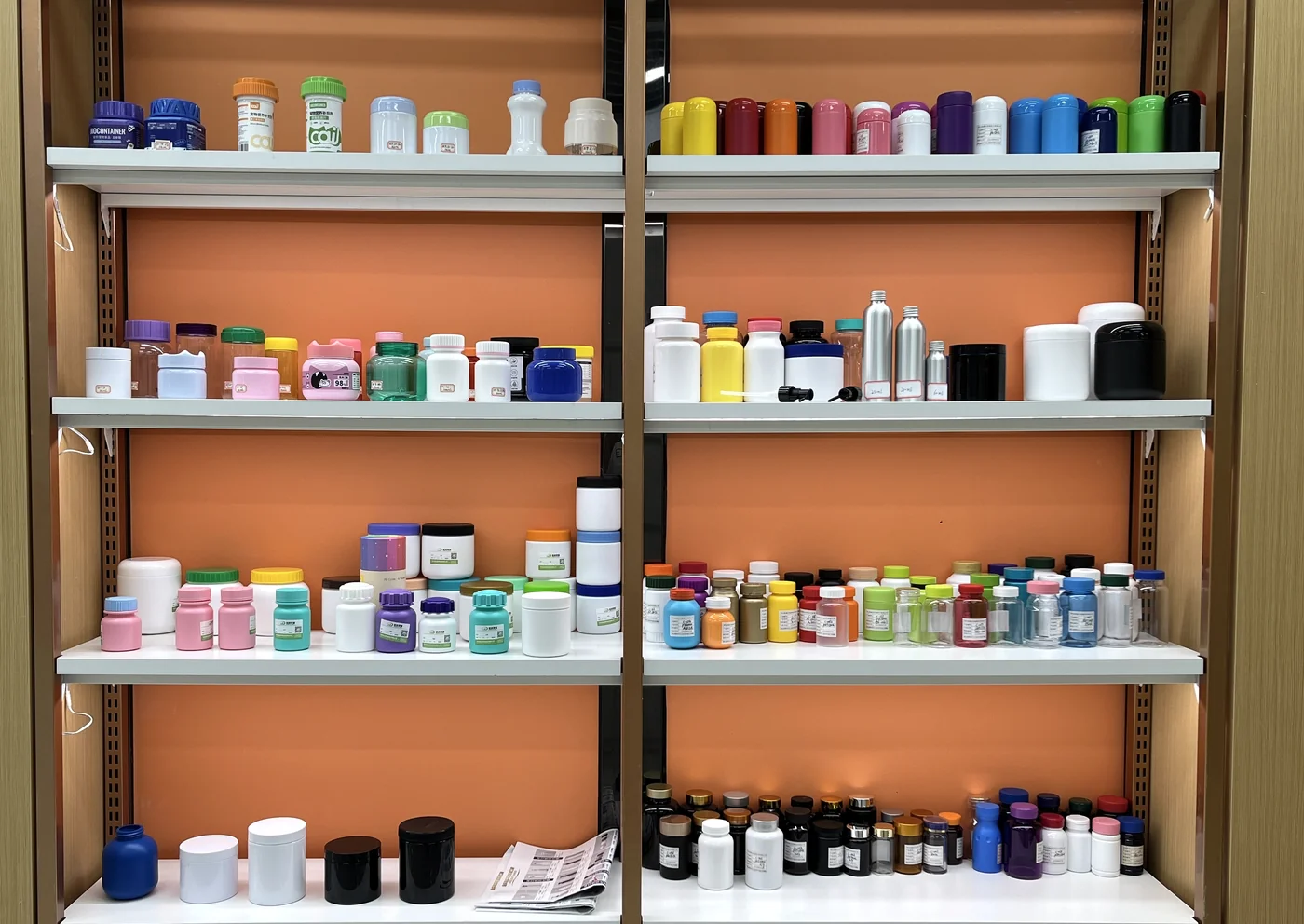
Stock bottles, closures, labels, and pouches require less development than custom molds, colors, structures, or elaborate decoration. Strong label design can still differentiate a standard container.
Bottles, jars, pouches, and individual sachets
Compare component cost, filling fit, barrier and seal requirements, packing labor, freight volume, and customer use. Sachets add unit-level steps; rigid containers occupy more space; pouches may need extra transport protection.
Labels, cartons, and print finishes
Label material, colors, finish, foil, embossing, special shapes, variable data, and short runs affect cost. A retail carton adds material, printing, packing, and freight volume.
Protect the product and the business case
Packaging should protect the formula, support truthful and market-appropriate labeling, survive distribution, and fit the intended sales channel. Review Pet Supplement Packaging Coordination when planning components and supplier coordination.
7. What Is the Difference Between an EXW Quote and Landed Cost?
EXW, FOB, and cost boundaries
Specify the Incoterms® rule, named place or port, and version in every quote. EXW makes goods available at the named collection point, with substantial onward responsibilities and costs for the buyer. FOB applies to sea or inland-waterway shipments and involves different seller obligations. Confirm which term suits the shipment.
Freight, insurance, clearance, duty, and destination charges
The manufacturing quote may exclude pickup, export handling, main freight, cargo insurance, customs brokerage, duty, taxes, examination, port or terminal charges, and local delivery. Rates and duties can change and depend on route, shipment profile, classification, origin, destination, and the policy in force at import.
Door-to-door delivery and DDP
Gukepet works with long-standing logistics partners to help small and medium-sized brands arrange door-to-door shipments, including buyers new to sourcing from China or without a familiar freight forwarder. DDP availability depends on the product and destination. Under DDP, the seller handles export and import clearance and applicable duties and taxes; the buyer normally unloads. Confirm the named destination, import arrangements, exclusions, and delivery scope. Door-to-door service alone does not establish DDP terms.
Calculate landed cost per bottle
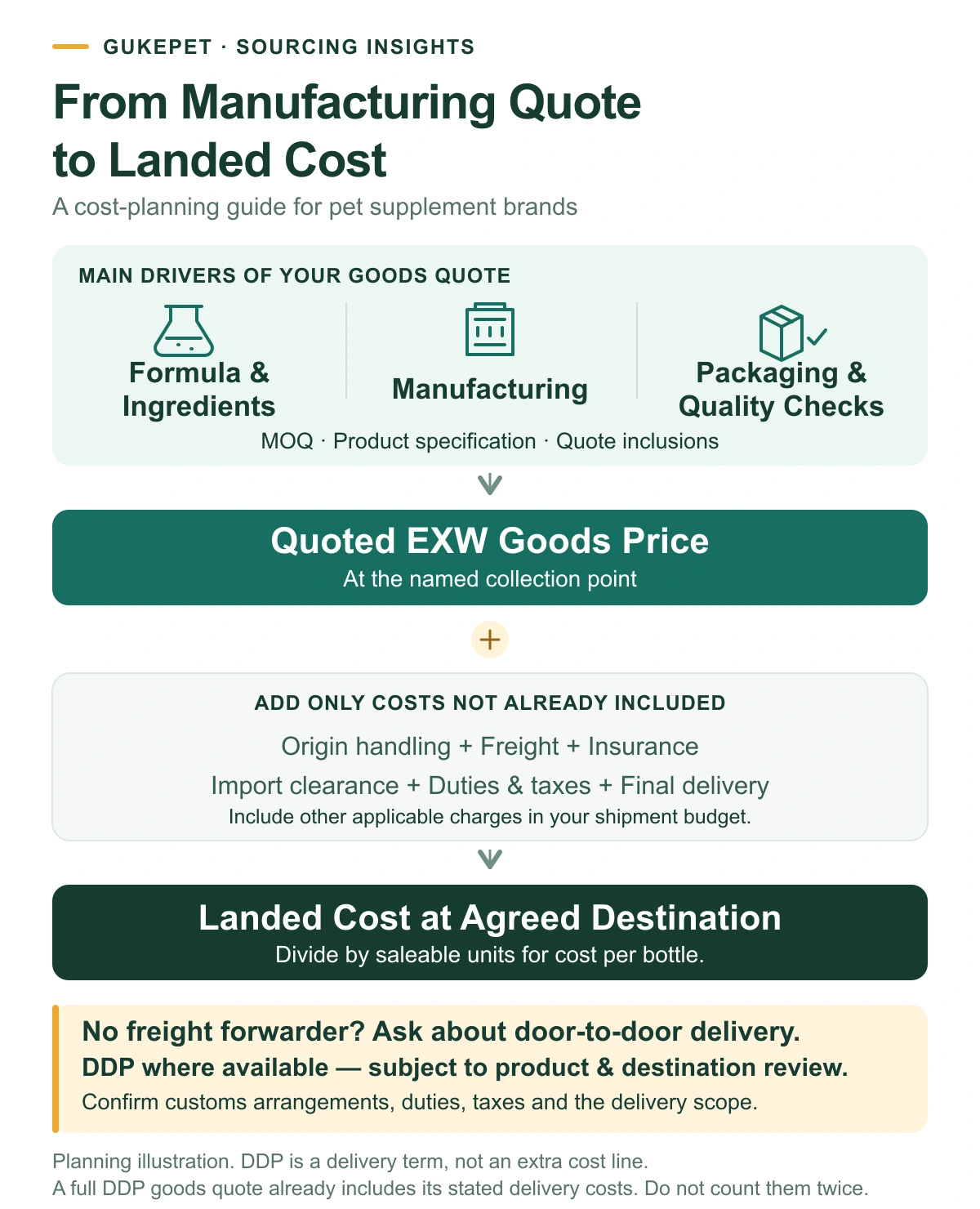
Use a quote-specific worksheet and add only charges not already included in the goods quote:
Landed batch cost = quoted goods + origin charges + freight + insurance + import duty/tax + brokerage/clearance + destination handling + local delivery + other applicable costs
Landed cost per saleable bottle = landed batch cost ÷ expected saleable bottles
This worksheet also supports shipment cash planning. Track recoverable VAT or similar taxes separately and exclude recoverable amounts from product cost when calculating margin. Confirm tax recovery and accounting treatment for your business.
8. How Do You Work Backward from Target Price and Margin?
Define the channel and net selling price
Start with realistic net revenue, not only the suggested retail price. A direct-to-consumer sale, distributor order, wholesale account, and marketplace transaction have different discounts, fees, fulfillment, return exposure, and marketing costs.
Set an acceptable landed-cost range
For a product-level planning estimate using landed inventory cost:
Gross margin % = (net sales revenue − landed product cost) ÷ net sales revenue × 100
For a fuller launch model, subtract channel fees, fulfillment, sales commissions, promotional allowances, returns, and marketing assumptions before setting the amount available for the product.
Work back to a target EXW manufacturing cost
Target EXW goods budget = target landed-goods budget − estimated freight, insurance, import, clearance, and destination costs
Use ranges until freight and import inputs are verified. Then tell potential partners the target cost, quantity, destination, and required specification so they can identify practical options.
Balance formula, format, packaging, and MOQ
If the concept exceeds the budget, compare alternatives: simplify optional ingredients, choose a suitable format, use standard packaging, adjust fill/count, or evaluate another order quantity. Record each specification change so the cost comparison remains meaningful.
Get a Manufacturing Cost Review to discuss the cost target and project variables.
9. How Should You Compare Quotes from Pet Supplement Manufacturing Partners in China?
Issue the same brief to every supplier
Send every supplier the same dated product brief and record approved substitutions. Use the checklist below to compare scope.
Compare production fit, quality scope, and documentation
Review production suitability, quality controls, and documents alongside price. See Quality Documentation & Testing for Gukepet’s coordination approach; documents and capabilities belong to the relevant manufacturing or testing party.
Lowest price does not always mean best fit
Compare inclusions, exclusions, ingredient specifications, tolerances, payment terms, and quote validity before choosing a supplier.
Use manufacturing-resource matching to improve total cost
Gukepet helps B2B buyers organize the brief, compare manufacturing partners, evaluate cost and MOQ, and coordinate the project. Verify each partner’s relevant equipment, facilities, certificates, and testing scope.
| Comparison item | Confirm in each quote | Cost implication |
|---|---|---|
| Formula/specification | Ingredient grade, actives per serving, and substitutions. | Formula differences change ingredient costs. |
| Quantity and tolerance | Units per SKU and overrun/underrun tolerance. | Batch size affects unit cost and cash outlay. |
| Count/fill and servings | Net content, unit count, and serving size. | Different fills distort per-bottle comparisons. |
| Packaging scope | Container, closure, seal, label, carton, and accessories. | Excluded components add cost. |
| Testing and documents | Included tests, reports, and supporting documents. | Testing scope affects quote comparability. |
| One-time charges | Samples, setup, artwork, tooling, and development. | Separate upfront fees from recurring prices. |
| Trade term and place | Incoterms® rule, version, and named delivery point. | Terms change logistics responsibilities and cost. |
| Freight and import | Freight, clearance, duties, taxes, and final delivery. | Add only charges not already included. |
| Lead time and validity | Lead-time trigger, dependencies, and quote expiry. | Timing changes can affect launch costs. |
10. What Should You Prepare Before Requesting a Manufacturing Cost Review?
If you already have a formula
Provide ingredient specifications and amounts, serving size, format, fill/count, target market, packaging, quantity, testing requirements, and acceptable substitutions. Agree on confidentiality and disclosure arrangements before sharing proprietary files.
If you are extending an existing product line
Share the customer need, benchmark positioning, preferred format, must-have and optional features, price architecture, launch timing, sales channel, and expected volume.
If you have a product direction and budget
Provide the pet type, product goal, target market, desired format, target retail or wholesale model, target EXW or landed-cost range, first-order quantity, and packaging direction. Unconfirmed items can remain open, but label assumptions so quotations remain comparable.
11. FAQ: Pet Supplement Manufacturing Cost and MOQ
How much does it cost to manufacture pet supplements in China?
There is no reliable universal price per bottle. The cost depends on the formula and ingredient specifications, dosage form, count or fill, packaging, testing and documentation, MOQ, manufacturing partner, and trade term. A usable estimate requires a defined project brief.
What are the main cost components of private label pet supplements?
The main components are formula and ingredients, processing, expected manufacturing loss, primary and secondary packaging, quality checks, testing and documents, samples or setup, and logistics. Confirm which items are included before comparing suppliers.
Can the MOQ be as low as 500 bottles?
Yes. Selected mature formulas from Gukepet’s manufacturing partners support 500-bottle orders. Custom-formula projects start at 1,000 bottles. Confirm the minimum for each formula, format, packaging combination, and SKU before placing an order.
Why do manufacturers quote different prices for the same product idea?
They may use different ingredient specifications, active levels, serving sizes, manufacturing assumptions, packaging, testing scope, quantities, or trade terms. Ask each supplier to quote the same written brief and disclose inclusions, exclusions, and substitutions.
Does an EXW price include packaging and international freight?
EXW describes an Incoterms® cost and responsibility boundary; it does not by itself define the product’s packaging scope. A quote may include agreed finished-product packaging but normally excludes substantial onward transport and import costs. Read the quote and contract together and state the named place and applicable Incoterms® version.
Can a custom formula be developed around a target budget?
Often, yes—if the target market, product direction, dosage form, quantity, packaging, and cost target are commercially compatible. Development still needs appropriate safety, quality, labeling, and target-market review. A budget is a design input, not a reason to make unsupported claims or hide specification changes.
Get a Manufacturing Cost Review
Have a formula or product idea? Share your market, format, quantity, packaging requirements, and target EXW or landed-cost range. Gukepet can compare suitable manufacturing partners in China and coordinate your next step.
Gukepet coordinates sourcing and manufacturing projects through third-party partners. Capabilities, certificates, and test reports should be checked against the specific manufacturing or service provider.